Dismissal With Prejudice, Without Prejudice, and Final Judgments
This page is education, not legal advice. It is not a substitute for advice from a lawyer about your facts. Most collection lawsuits are filed in state court. Those courts apply their own dismissal rules and their own law of judgments. This page does not publish a 50-state chart. Where this page quotes Federal Rule of Civil Procedure 41, that rule is labeled as a federal-court illustration. It is not the dismissal rule of a state collection court. The Supreme Court cases quoted below define claim preclusion and issue preclusion in federal terms. A state court may use the same vocabulary and still apply its own precedents. Read the official text that applies to your matter.
The label on a dismissal order matters. "Without prejudice" and "with prejudice," and the related phrase "adjudication on the merits," are not decorative. They help decide whether the same claim may be filed again, and whether a later case is blocked by a final judgment already entered. A companion page on this site covers what can follow if you do not answer a collection lawsuit, including default judgment. This page stays on dismissals and on what a final judgment can preclude.
What "With Prejudice" and "Without Prejudice" Mean
A dismissal without prejudice is a dismissal that, as a general matter, leaves the plaintiff free to file the claim again, subject to any independent deadline such as a statute of limitations. A dismissal with prejudice, or a dismissal that operates as an adjudication on the merits, is a dismissal that treats the claim as concluded. The second kind of dismissal is the kind that can support claim preclusion, also called res judicata, if the other requirements of that doctrine are met.
Those are general descriptions. The effect of a particular order depends on what the order says and on the law of the court that entered it. An order can state that a dismissal is with prejudice or without prejudice. Some rules also supply a default effect when the order is silent.
A Federal-Court Illustration: Rule 41
Federal Rule of Civil Procedure 41 governs dismissal of actions in the United States district courts. The next several paragraphs are a federal-court illustration. If you have a case in state court, read that state's dismissal rule. Many collection cases never enter a federal court at all.
Rule 41(a) addresses voluntary dismissal, which is a dismissal the plaintiff seeks. Under Rule 41(a)(1)(A), subject to certain class-action, derivative, unincorporated-association, and receivership rules and any applicable federal statute, the plaintiff may dismiss an action without a court order by filing a notice of dismissal before the opposing party serves either an answer or a motion for summary judgment, or a stipulation of dismissal signed by all parties who have appeared.
Rule 41(a)(1)(B) states the effect of that notice or stipulation. Unless the notice or stipulation states otherwise, the dismissal is without prejudice. But if the plaintiff previously dismissed any federal- or state-court action based on or including the same claim, a notice of dismissal operates as an adjudication on the merits. That second sentence is the two-dismissal rule in the federal text. The first voluntary dismissal by notice is, unless it states otherwise, without prejudice. A later notice of dismissal of an action based on or including the same claim operates as an adjudication on the merits.
If the plaintiff cannot dismiss under Rule 41(a)(1), Rule 41(a)(2) provides that an action may be dismissed at the plaintiff's request only by court order, on terms that the court considers proper. If a defendant has pleaded a counterclaim before being served with the plaintiff's motion to dismiss, the action may be dismissed over the defendant's objection only if the counterclaim can remain pending for independent adjudication. Unless the order states otherwise, a dismissal under Rule 41(a)(2) is without prejudice.
Rule 41(b) addresses involuntary dismissal. If the plaintiff fails to prosecute or to comply with the federal rules or a court order, a defendant may move to dismiss the action or any claim against it. Unless the dismissal order states otherwise, a dismissal under Rule 41(b) and any dismissal not under this rule—except one for lack of jurisdiction, improper venue, or failure to join a party under Rule 19—operates as an adjudication on the merits.
Two points in that last sentence are easy to miss. First, the default effect of an involuntary dismissal under the federal rule is an adjudication on the merits, unless the order states otherwise. Second, dismissals for lack of jurisdiction, improper venue, or failure to join a party under Rule 19 are carved out of that default. Those carve-outs are consistent with the idea, discussed on a companion page, that a dismissal for lack of subject-matter jurisdiction or improper venue is not a decision of the claim itself.
A state collection court will have its own voluntary-dismissal rule, its own two-dismissal or failure-to-prosecute practice, and its own default effect when an order is silent. Do not assume that Rule 41 is the rule that court will apply.
Claim Preclusion and Issue Preclusion
A final judgment can do more than end the case in which it was entered. It can also limit later litigation between the same parties, or those in privity with them, through two related doctrines.
The Supreme Court described both doctrines in Taylor v. Sturgell, 553 U.S. 880 (2008). The Court stated that the preclusive effect of a judgment is defined by claim preclusion and issue preclusion, which are collectively referred to as "res judicata." Under the doctrine of claim preclusion, a final judgment forecloses successive litigation of the very same claim, whether or not relitigation of the claim raises the same issues as the earlier suit. Issue preclusion, in contrast, bars successive litigation of an issue of fact or law actually litigated and resolved in a valid court determination essential to the prior judgment, even if the issue recurs in the context of a different claim. Issue preclusion is also commonly called collateral estoppel.
The Court returned to the same vocabulary in Lucky Brand Dungarees, Inc. v. Marcel Fashions Group, Inc., 590 U.S. 405 (2020). The opinion describes res judicata as a term comprising the doctrine of issue preclusion, which precludes a party from relitigating an issue actually decided in a prior action and necessary to the judgment, and the doctrine of claim preclusion, which prevents parties from raising issues that could have been raised and decided in a prior action. For claim preclusion to apply, the Court stated, the causes of action must share a "common nucleus of operative fact[s]." The Court also stated that claim preclusion generally does not bar claims that are predicated on events that postdate the filing of the initial complaint, because events occurring after a plaintiff files suit often give rise to new operative facts creating a new claim to relief.
Those definitions are the Court's own. They do not decide whether a particular collection dismissal or a particular default judgment bars a later filing in a particular state court. Claim preclusion generally requires a final judgment, the same parties or those in privity with them, and the same claim, often described as a common nucleus of operative facts. Issue preclusion generally requires that the issue was actually litigated and essential to the prior judgment. A default judgment is a judgment, and a companion page on this site covers how one can be entered when a defendant does not answer. Whether that judgment has claim-preclusive or issue-preclusive effect, and on which issues, is a question for the law of the court that would be asked to give it that effect. This page does not invent a uniform national answer.
A dismissal without prejudice, or a dismissal for lack of jurisdiction or improper venue under a rule like the federal carve-out described above, is generally not a final decision of the claim on the merits. A dismissal with prejudice, or a dismissal that the applicable rule treats as an adjudication on the merits, can be. The order itself is the first text to read.
What This Means If a Collection Case Was Dismissed or Went to Judgment
If a collector dismissed a case and later filed again, the first question is what the first order said, and under what rule it was entered. A first voluntary dismissal without prejudice may leave the claim open, subject to the statute of limitations. A second dismissal, a dismissal with prejudice, or a judgment on the merits may not. If you already have a final judgment on the same claim, or a dismissal that the applicable law treats as an adjudication on the merits, that judgment is a fact the later court will be asked to consider.
These doctrines cut both ways. They can block a collector from suing again on the same claim after a final decision, and they can also block a consumer from relitigating an issue that was actually decided in an earlier case. Neither result is automatic from the caption of a case. The official text of the order, the rule under which it was entered, and the preclusion law of the forum all matter.
A later lawsuit is also not the only setting in which a judgment has consequences. A money judgment can lead to wage garnishment or a bank levy, which a companion page on this site covers. A Bureau complaint, a credit-report dispute, or a letter to a collector does not vacate a judgment and does not take the place of whatever procedure the court of judgment provides for challenging or satisfying it.
What This Page Does Not Decide
This page does not tell you whether a particular dismissal was with or without prejudice, whether a two-dismissal rule in your forum was triggered, or whether a particular judgment bars a later case. Those questions turn on the order, on the official text of the forum, and on facts. Compare that text with the papers in the court file, and get legal help when you need it for a specific case.
Sources
- Federal Rule of Civil Procedure 41(a) and (b). Dismissal of actions. Legal Information Institute, Cornell Law School. Federal-court illustration.
https://www.law.cornell.edu/rules/frcp/rule_41 - Taylor v. Sturgell, 553 U.S. 880 (2008). Official United States Reports, GovInfo; Justia U.S. Supreme Court Center.
https://www.govinfo.gov/content/pkg/USREPORTS-553/pdf/USREPORTS-553-880.pdf https://supreme.justia.com/cases/federal/us/553/880/ - Lucky Brand Dungarees, Inc. v. Marcel Fashions Group, Inc., 590 U.S. 405 (2020). Official slip opinion, Supreme Court of the United States; Legal Information Institute, Cornell Law School.
https://www.supremecourt.gov/opinions/19pdf/18-1086_new_5ifl.pdf https://www.law.cornell.edu/supremecourt/text/18-1086
Further Reading
The books below are from this publisher's catalog. Links go to the publisher's own titles on Amazon. This site has not joined the Amazon Associates program and does not earn a referral commission from these links.
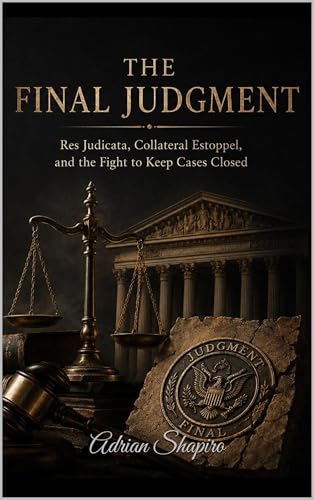 THE FINAL JUDGMENT: Res Judicata, Collateral Estoppel, and the Fight to Keep Cases Closedhttps://www.amazon.com/dp/B0H2GKCK6D
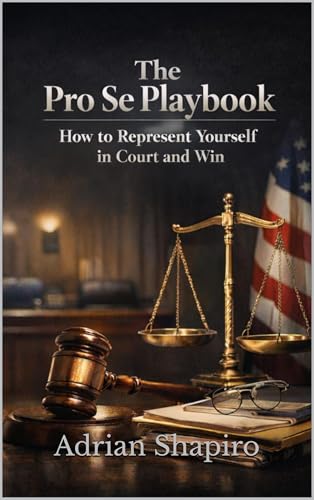 The Pro Se Playbook: How to Represent Yourself in Court and Winhttps://www.amazon.com/dp/B0GX58LSFP