Enforcing a Lost, Destroyed, or Stolen Promissory Note Under UCC 3-309
This page is education, not legal advice. It is not a substitute for advice from a lawyer about your facts. Article 3 of the Uniform Commercial Code is state law. States enact the uniform text, sometimes with local changes. Section 3-309 itself exists in more than one official uniform version. The 1990 text and the 2002 revision differ on who may enforce an instrument that was lost before the current claimant obtained it. Some states still use the 1990 wording. Others have enacted the 2002 wording. This page does not publish a 50-state chart. Read the official text in force in the relevant state.
A person who sues on a note is often expected to produce it. Article 3 also supplies a path for a person who is not in possession. That path is narrow, and it is not a substitute for proving the terms of the instrument and the right to enforce it. Companion pages on this site cover who is a person entitled to enforce a note and what a collection plaintiff has to prove. This page stays on Section 3-309.
How Section 3-301 Fits with Section 3-309
Section 3-301 defines "person entitled to enforce" an instrument to mean (i) the holder of the instrument, (ii) a nonholder in possession of the instrument who has the rights of a holder, or (iii) a person not in possession of the instrument who is entitled to enforce the instrument pursuant to Section 3-309 or 3-418(d). A person may be a person entitled to enforce the instrument even though the person is not the owner of the instrument or is in wrongful possession of the instrument.
The third branch is the lost-instrument path. It does not say that anyone who claims to have once had a note may enforce it. It points to Section 3-309 (and to Section 3-418(d), which this page does not unpack). If the claimant is not in possession, Section 3-309 is the first text to read.
The 1990 Text: Possession When the Loss Occurred
The 1990 uniform text of Section 3-309(a) allowed a person not in possession to enforce the instrument if three conditions were met. First, the person was in possession of the instrument and entitled to enforce it when loss of possession occurred. Second, the loss of possession was not the result of a transfer by the person or a lawful seizure. Third, the person cannot reasonably obtain possession of the instrument because the instrument was destroyed, its whereabouts cannot be determined, or it is in the wrongful possession of an unknown person or a person that cannot be found or is not amenable to service of process.
That first condition is the one that later changed. Under the 1990 wording, the person seeking to enforce had to have been in possession, and entitled to enforce, when the loss occurred. A later purchaser who never had the paper did not meet that clause as written.
Some states still enact that wording. The Illinois statute, 810 ILCS 5/3-309, is one official example. It tracks the 1990 uniform text: a person not in possession is entitled to enforce if the person was in possession of the instrument and entitled to enforce it when loss of possession occurred, the loss was not the result of a transfer by the person or a lawful seizure, and the person cannot reasonably obtain possession for one of the listed reasons. Illinois is an illustration of the 1990 wording, not a map of every state.
The 2002 Revision: Ownership Acquired from a Person Who Could Have Enforced
In 2002, the uniform text of Section 3-309(a) was revised. Cornell LII displays that revised uniform text. A person not in possession of an instrument is entitled to enforce the instrument if three numbered conditions are met.
The first condition is the change. The person seeking to enforce the instrument either (A) was entitled to enforce the instrument when loss of possession occurred, or (B) has directly or indirectly acquired ownership of the instrument from a person who was entitled to enforce the instrument when loss of possession occurred. The revised first condition does not, as written, require that the current claimant have been in possession when the loss occurred. It allows a later owner who acquired ownership, directly or indirectly, from a person who was entitled to enforce at the time of the loss.
The second and third conditions remain in substance the same as the later clauses of the 1990 text. The loss of possession was not the result of a transfer by the person or a lawful seizure, and the person cannot reasonably obtain possession because the instrument was destroyed, its whereabouts cannot be determined, or it is in the wrongful possession of an unknown person or a person that cannot be found or is not amenable to service of process.
Some states have enacted that revised wording. The Texas Business and Commerce Code, Section 3.309, as amended in 2005, is one official example. It states that a person who is not in possession is entitled to enforce if the person seeking to enforce either was entitled to enforce the instrument when loss of possession occurred, or has directly or indirectly acquired ownership of the instrument from a person who was entitled to enforce the instrument when loss of possession occurred, and if the other two conditions are met. Texas is an illustration of the 2002 wording, not a map of every state.
Which version applies is a question of the statute of the relevant state, as enacted and as later amended. Do not assume that the Cornell LII uniform page is the law of the forum. Do not assume that a later buyer of a lost note can enforce it in a state that still uses the 1990 possession-when-lost wording. Compare the official state text with the facts of possession, transfer, and ownership.
Proof of Terms, Section 3-308, and Adequate Protection
Subsection (b) of Section 3-309 is the same in both the 1990 text and the 2002 revision, and it is the same in the Illinois and Texas enactments just quoted. A person seeking enforcement of an instrument under subsection (a) must prove the terms of the instrument and the person's right to enforce the instrument. If that proof is made, Section 3-308 applies to the case as if the person seeking enforcement had produced the instrument. The court may not enter judgment in favor of the person seeking enforcement unless it finds that the person required to pay the instrument is adequately protected against loss that might occur by reason of a claim by another person to enforce the instrument. Adequate protection may be provided by any reasonable means.
Two requirements sit in that paragraph besides the threshold in subsection (a). The claimant must prove the terms of the instrument and the right to enforce it. And the court may not enter judgment unless it finds adequate protection against a later claim by someone else on the same instrument. The statute does not list a single required form of protection. It says adequate protection may be provided by any reasonable means. What is adequate in a particular case is a question for the court applying the official text.
Section 3-308 is the proof section that subsection (b) incorporates once those showings are made, as if the instrument had been produced. In an action with respect to an instrument, the authenticity of, and authority to make, each signature on the instrument is admitted unless specifically denied in the pleadings. If the validity of a signature is denied in the pleadings, the burden of establishing validity is on the person claiming validity, but the signature is presumed to be authentic and authorized, subject to the exception the section states for a purported signer who is dead or incompetent at the time of trial of that issue.
If the validity of signatures is admitted or proved and there is compliance with subsection (a), a plaintiff producing the instrument is entitled to payment if the plaintiff proves entitlement to enforce the instrument under Section 3-301, unless the defendant proves a defense or claim in recoupment. If a defense or claim in recoupment is proved, the right to payment is subject to that defense or claim, except to the extent the plaintiff proves rights of a holder in due course which are not subject to the defense or claim. Under Section 3-309(b), those proof rules apply as if the lost-instrument claimant had produced the paper. They do not excuse the claimant from proving the terms of the instrument, the right to enforce it, or adequate protection.
What This Means in a Collection Case
A lost, destroyed, or stolen note is not automatically unenforceable, and it is not automatically enforceable. The plaintiff who does not produce the instrument has to meet the enacted version of Section 3-309 in the forum, including the possession-when-lost wording or the later ownership wording, whichever that state has adopted. The plaintiff also has to prove the terms and the right to enforce, and the court may not enter judgment without a finding of adequate protection.
A lost-note affidavit, or a lost-instrument count in a complaint, is not a judgment. The official text still has to be compared with the facts: who had the instrument when it was lost, whether the current claimant was that person or later acquired ownership from such a person, whether the loss was a transfer or a lawful seizure, and why possession cannot reasonably be obtained. Those are fact questions. This page does not decide them.
What This Page Does Not Decide
This page does not tell you which version of Section 3-309 your state has enacted, whether a particular claimant was entitled to enforce when a note was lost, or what form of adequate protection a court would require. Those questions turn on the official state text and on facts. Compare that text with the papers in the file, and get legal help when you need it for a specific case.
Sources
- UCC s. 3-301. Person entitled to enforce instrument. Legal Information Institute, Cornell Law School.
https://www.law.cornell.edu/ucc/3/3-301 - UCC s. 3-308. Proof of signatures and status as holder in due course. Legal Information Institute, Cornell Law School.
https://www.law.cornell.edu/ucc/3/3-308 - UCC s. 3-309. Enforcement of lost, destroyed, or stolen instrument (2002 uniform text). Legal Information Institute, Cornell Law School.
https://www.law.cornell.edu/ucc/3/3-309 - 810 ILCS 5/3-309. Enforcement of lost, destroyed, or stolen instrument (Illinois enactment of the 1990 uniform wording). Illinois General Assembly.
https://www.ilga.gov/legislation/ilcs/documents/081000050K3-309.htm - Texas Business and Commerce Code s. 3.309, as amended by Acts 2005, 79th Leg., ch. 95, s. 6 (Texas enactment of the 2002 uniform wording). Texas Constitution and Statutes.
https://statutes.capitol.texas.gov/Docs/BC/htm/BC.3.htm
Further Reading
The books below are from this publisher's catalog. Links go to the publisher's own titles on Amazon. This site has not joined the Amazon Associates program and does not earn a referral commission from these links.
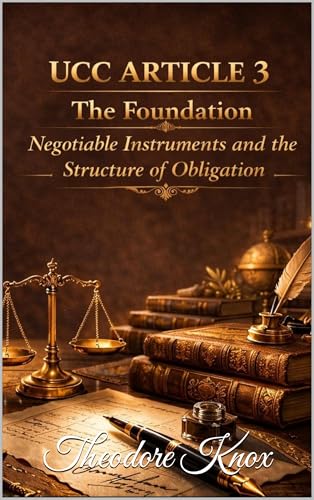 UCC Article 3 — The Foundation: Negotiable Instruments and the Structure of Obligationhttps://www.amazon.com/dp/B0GT74Z3H2
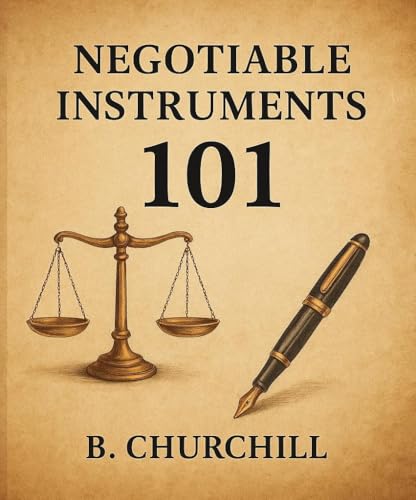 Negotiable Instruments 101: A Plain-English Guide to the UCC, Public Law 73-10, and Lawful Dischargehttps://www.amazon.com/dp/B0FWYXD9R3