Holder in Due Course Under UCC Article 3
This page is education, not legal advice. It is not a substitute for advice from a lawyer about your facts. Article 3 of the Uniform Commercial Code is state law. States enact the uniform text, sometimes with changes. Other law, including federal consumer-credit rules, can limit holder-in-due-course status in particular classes of transactions. Read the official text in force in the relevant state, and the other law that applies to the transaction.
"Holder in due course" is a defined status. It is not a synonym for "holder," and it is not a synonym for "person entitled to enforce." A person can be entitled to enforce an instrument without being a holder in due course. The payoff of the status, when it exists, is a narrower set of defenses and claims that may be asserted against that person.
This page assumes the writing is a negotiable instrument. A companion page on this site explains the Article 3 tests for that classification. Another companion page explains who is a person entitled to enforce a note, including who is a holder. Holder-in-due-course status builds on those two questions.
The Starting Point Is a Holder
Section 3-302(a) defines "holder in due course" as the holder of an instrument who meets the rest of the section's tests. If the person is not a holder, the holder-in-due-course definition does not get off the ground. The companion page on persons entitled to enforce covers that first step: possession of an instrument payable to bearer, or payable to the identified person in possession.
Section 3-302(a) is also subject to subsection (c) and to Section 3-106(d). This page does not unpack Section 3-106(d). Subsection (c) is taken up below.
The Statutory Tests
Subject to those limits, Section 3-302(a) requires two things.
First, the instrument when issued or negotiated to the holder must not bear such apparent evidence of forgery or alteration, and must not otherwise be so irregular or incomplete, as to call into question its authenticity.
Second, the holder must have taken the instrument (i) for value, (ii) in good faith, (iii) without notice that the instrument is overdue or has been dishonored or that there is an uncured default with respect to payment of another instrument issued as part of the same series, (iv) without notice that the instrument contains an unauthorized signature or has been altered, (v) without notice of any claim to the instrument described in Section 3-306, and (vi) without notice that any party has a defense or claim in recoupment described in Section 3-305(a).
Each of those notice items is a separate condition. The definition is conjunctive. Missing one element means the taker is a holder, if the holder tests are met, but not a holder in due course.
Section 3-302(b) adds two clarifications. Notice of discharge of a party, other than discharge in an insolvency proceeding, is not notice of a defense under subsection (a), but that discharge is effective against a holder in due course who took with notice of it. Public filing or recording of a document is not, of itself, notice of a defense, claim in recoupment, or claim to the instrument.
Section 3-302(f) states when notice is effective: it must be received at a time and in a manner that gives a reasonable opportunity to act on it.
Section 3-302(d) limits the status when the consideration has been only partly performed. If, under Section 3-303(a)(1), the promise of performance that is the consideration for an instrument has been partially performed, the holder may assert rights as a holder in due course only to the fraction of the amount payable equal to the value of the partial performance divided by the value of the promised performance.
When the Status Is Not Acquired by the Taking
Section 3-302(c) is a hard stop for certain acquisitions. Except to the extent a transferor or predecessor in interest has rights as a holder in due course, a person does not acquire rights of a holder in due course of an instrument taken (i) by legal process or by purchase in an execution, bankruptcy, or creditor's sale or similar proceeding, (ii) by purchase as part of a bulk transaction not in ordinary course of business of the transferor, or (iii) as the successor in interest to an estate or other organization.
A later taker in one of those settings can still have holder-in-due-course rights if a predecessor already had them. The taker does not earn those rights merely by the form of the taking.
What Defenses Survive, and What Does Not
Section 3-305 is the defense statute. Section 3-305(a) says that, except as otherwise provided in the section, the right to enforce the obligation of a party to pay an instrument is subject to three categories.
The first category, in Section 3-305(a)(1), is a defense of the obligor based on (i) infancy of the obligor to the extent it is a defense to a simple contract, (ii) duress, lack of legal capacity, or illegality of the transaction which, under other law, nullifies the obligation of the obligor, (iii) fraud that induced the obligor to sign the instrument with neither knowledge nor reasonable opportunity to learn of its character or its essential terms, or (iv) discharge of the obligor in insolvency proceedings. These are the defenses often called "real defenses." The uniform text itself uses the numbered categories, not that label. Notice the limits inside the list. Illegality counts only if other law nullifies the obligation. The fraud that belongs here is fraud that left the signer without knowledge or a reasonable opportunity to learn the character or essential terms of the instrument. Ordinary claims that the deal was misrepresented, or that the goods were defective, are not in this first list.
The second category, in Section 3-305(a)(2), is a defense of the obligor stated in another section of Article 3, or a defense of the obligor that would be available if the person entitled to enforce the instrument were enforcing a right to payment under a simple contract. Those contract defenses are often called "personal defenses."
The third category, in Section 3-305(a)(3), is a claim in recoupment of the obligor against the original payee of the instrument if the claim arose from the transaction that gave rise to the instrument. The obligor may assert that claim against a transferee only to reduce the amount owing on the instrument at the time the action is brought.
Section 3-305(b) then states the effect of holder-in-due-course status. The right of a holder in due course to enforce the obligation is subject to the defenses in subsection (a)(1), but is not subject to the defenses in subsection (a)(2) or to claims in recoupment in subsection (a)(3) against a person other than the holder.
In short: a holder in due course still faces the subsection (a)(1) defenses. Ordinary contract defenses and recoupment claims against someone else do not cut off that holder in the same way. A person who is entitled to enforce but is not a holder in due course remains subject to the broader set in Section 3-305(a).
Claims to the Instrument
Section 3-306 is one paragraph. A person taking an instrument, other than a person having rights of a holder in due course, is subject to a claim of a property or possessory right in the instrument or its proceeds, including a claim to rescind a negotiation and to recover the instrument or its proceeds. A person having rights of a holder in due course takes free of the claim to the instrument.
The distinction is between a defense to payment, which lives in Section 3-305, and a claim that the instrument itself belongs to someone else, which lives in Section 3-306. Holder-in-due-course rights cut off the latter.
Consumer Transactions and the FTC Holder Rule
Section 3-302(g) states that the holder-in-due-course section is subject to any law limiting status as a holder in due course in particular classes of transactions. Section 3-305(f) says the defense section is subject to law other than Article 3 that establishes a different rule for consumer transactions. Section 3-305(e) addresses a consumer transaction in which other law requires the instrument to include a statement that the rights of a holder or transferee are subject to a claim or defense that the issuer could assert against the original payee. If the instrument omits that statement, the instrument has the same effect as if it included the statement, the issuer may assert the claims and defenses that would have been available if it had, and the extent of those claims is determined as if the statement were included.
One such federal rule is the Federal Trade Commission's Holder Rule, 16 C.F.R. Part 433. Section 433.2 provides that, in connection with any sale or lease of goods or services to consumers, in or affecting commerce, it is an unfair or deceptive act or practice for a seller to take or receive a consumer credit contract that fails to contain a required notice, in at least ten-point boldface type, stating that any holder of the consumer credit contract is subject to all claims and defenses which the debtor could assert against the seller of goods or services obtained pursuant to the contract or with the proceeds, and that recovery by the debtor shall not exceed amounts paid by the debtor under the contract. The same notice is required, with slightly different wording, when the seller accepts the proceeds of a purchase-money loan as payment.
Section 433.1 supplies the definitions that limit the rule's reach. A "consumer" is a natural person who seeks or acquires goods or services for personal, family, or household use. A "consumer credit contract" is an instrument which evidences or embodies a debt arising from a purchase-money loan or a financed sale, as those terms are defined in the rule. The rule's definition of "creditor" excludes a person acting, for the purposes of a particular transaction, in the capacity of a credit-card issuer. The Holder Rule is not a general repeal of holder-in-due-course doctrine. It is a federal limit on cut-off of consumer claims and defenses in the covered transactions, and recovery is capped at amounts the debtor has paid under the contract.
Whether a particular contract is a covered consumer credit contract is a fact question this page does not answer.
What This Page Does Not Decide
This page does not tell you whether a particular writing is a negotiable instrument, whether a particular taker is a holder or a holder in due course, or whether a particular consumer contract is covered by the Holder Rule. Those questions turn on the official text in force and on facts. Compare that text with the instrument and the papers in your file, and get legal help when you need it for a case.
Sources
- UCC s. 3-302. Holder in Due Course. Legal Information Institute, Cornell Law School. https://www.law.cornell.edu/ucc/3/3-302
- UCC s. 3-305. Defenses and Claims in Recoupment. Legal Information Institute, Cornell Law School. https://www.law.cornell.edu/ucc/3/3-305
- UCC s. 3-306. Claims to an Instrument. Legal Information Institute, Cornell Law School. https://www.law.cornell.edu/ucc/3/3-306
- 16 C.F.R. Part 433. Preservation of Consumers' Claims and Defenses. Electronic Code of Federal Regulations. https://www.ecfr.gov/current/title-16/part-433
Further Reading
The books below are from this publisher's catalog. Links go to the publisher's own titles on Amazon. This site has not joined the Amazon Associates program and does not earn a referral commission from these links.
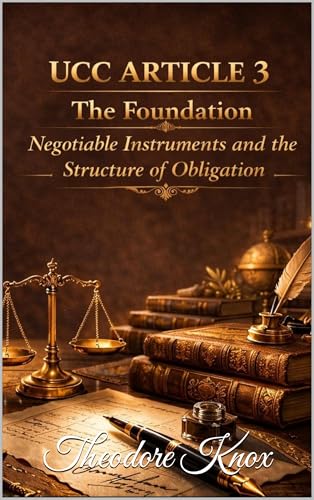 UCC Article 3 — The Foundation: Negotiable Instruments and the Structure of Obligationhttps://www.amazon.com/dp/B0GT74Z3H2
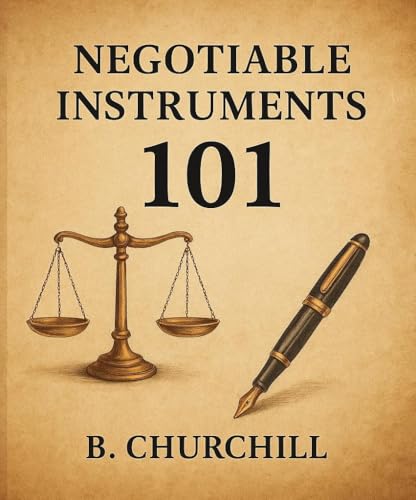 Negotiable Instruments 101: A Plain-English Guide to the UCC, Public Law 73-10, and Lawful Dischargehttps://www.amazon.com/dp/B0FWYXD9R3