How a Security Interest Attaches and Becomes Perfected
This page is education, not legal advice. It is not a substitute for advice from a lawyer about your facts. Article 9 of the Uniform Commercial Code is state law. States enact the uniform text, sometimes with changes. Read the official text in force in the relevant state.
Attachment and perfection are two different events. Attachment is when a security interest becomes enforceable against the debtor with respect to the collateral. Perfection is a further step that matters for priority against competing claimants. A financing statement can help perfect many interests. It does not, by itself, attach them.
A companion page on this site maps Article 9's scope and the defined terms "debtor," "secured party," "collateral," and "security agreement." Another companion page explains the UCC-1 financing statement. This page stays with the tests for attachment, the methods of perfection, and the basic priority rule among conflicting security interests.
When a Security Interest Attaches
Section 9-203(a) states the first rule. A security interest attaches to collateral when it becomes enforceable against the debtor with respect to the collateral, unless an agreement expressly postpones the time of attachment.
Section 9-203(b) then states when the interest is enforceable against the debtor and third parties with respect to the collateral. Except as otherwise provided in subsections (c) through (i), three conditions must be met.
First, value has been given.
Second, the debtor has rights in the collateral or the power to transfer rights in the collateral to a secured party.
Third, one of the listed methods is met. The most common method, in Section 9-203(b)(3)(A), is that the debtor has authenticated a security agreement that provides a description of the collateral and, if the security interest covers timber to be cut, a description of the land concerned. The other methods in subsection (b)(3) are possession of certain collateral by the secured party under Section 9-313 pursuant to the debtor's security agreement, delivery of a certificated security in registered form under Section 8-301 pursuant to the debtor's security agreement, and control of deposit accounts, electronic chattel paper, investment property, or letter-of-credit rights under the control sections named in the statute, again pursuant to the debtor's security agreement.
All three conditions are required. An authenticated security agreement with a collateral description does not attach the interest if value has not been given, or if the debtor has no rights in the collateral and no power to transfer those rights. A financing statement filed before a security agreement is made does not fill that gap. The companion page on financing statements notes that a financing statement may be filed before a security agreement is made or a security interest otherwise attaches. Filing early is not attachment.
Section 9-203(f) adds a related consequence. The attachment of a security interest in collateral gives the secured party the rights to proceeds provided by Section 9-315 and is also attachment of a security interest in a supporting obligation for the collateral. This page names Section 9-315 only as Section 9-203(f) names it.
When the Interest Is Perfected
Section 9-308(a) states the general rule. Except as otherwise provided in that section and Section 9-309, a security interest is perfected if it has attached and all of the applicable requirements for perfection in Sections 9-310 through 9-316 have been satisfied. A security interest is perfected when it attaches if the applicable requirements are satisfied before the security interest attaches.
Perfection therefore has two parts: attachment, plus the applicable perfection method. If the method is already in place when the interest attaches, perfection and attachment happen together. If the method comes later, perfection waits for it.
Section 9-308(c) addresses a change in method. A security interest or agricultural lien is perfected continuously if it is originally perfected by one method under Article 9 and is later perfected by another method under Article 9, without an intermediate period when it was unperfected. A gap in the middle breaks that continuity.
Filing Is the Ordinary Method, with Listed Exceptions
Section 9-310(a) is the general rule on filing. Except as otherwise provided in subsection (b) and Section 9-312(b), a financing statement must be filed to perfect all security interests and agricultural liens.
Section 9-310(b) then lists the exceptions. The filing of a financing statement is not necessary to perfect a security interest that is perfected under Section 9-308(d), (e), (f), or (g); that is perfected under Section 9-309 when it attaches; in property subject to a statute, regulation, or treaty described in Section 9-311(a); in goods in possession of a bailee which is perfected under Section 9-312(d)(1) or (2); in certificated securities, documents, goods, or instruments which is perfected without filing or possession under Section 9-312(e), (f), or (g); in collateral in the secured party's possession under Section 9-313; in a certificated security perfected by delivery under Section 9-313; in deposit accounts, electronic chattel paper, investment property, or letter-of-credit rights perfected by control under Section 9-314; in proceeds perfected under Section 9-315; or that is perfected under Section 9-316.
The list is a set of other methods, not a reason to ignore filing in the ordinary case. For many security interests in ordinary goods, filing remains the method the statute requires.
Automatic Perfection Upon Attachment
Section 9-309 lists security interests that are perfected when they attach. The first item is a purchase-money security interest in consumer goods, except as otherwise provided in Section 9-311(b) with respect to consumer goods that are subject to a statute or treaty described in Section 9-311(a). The rest of the list includes, among other items, certain assignments of accounts or payment intangibles that do not transfer a significant part of the assignor's outstanding accounts or payment intangibles, a sale of a payment intangible, a sale of a promissory note, and several interests that arise under other UCC articles.
The consumer-goods exception is the one most people meet. Automatic perfection under Section 9-309(1) does not apply where Section 9-311(b) requires compliance with another statute or treaty described in Section 9-311(a). Section 9-311(a) includes a statute, regulation, or treaty of the United States whose requirements preempt Section 9-310(a), and it includes certificate-of-title statutes of the kind a state lists in the uniform text, such as statutes covering automobiles and similar goods. Section 9-311(b) provides that, except as otherwise provided in that section and in the other sections it names, a security interest in property subject to such a statute, regulation, or treaty may be perfected only by compliance with those requirements. A purchase-money security interest in a car that is covered by a certificate-of-title statute is not perfected merely because the interest attached.
Possession and Control
Section 9-313(a) states that, except as otherwise provided in subsection (b), a secured party may perfect a security interest in negotiable documents, goods, instruments, money, or tangible chattel paper by taking possession of the collateral. A secured party may perfect a security interest in certificated securities by taking delivery of the certificated securities under Section 8-301. Section 9-313(d) times that method: if perfection depends upon possession, perfection occurs no earlier than the time the secured party takes possession and continues only while the secured party retains possession.
Section 9-314(a) states that a security interest in investment property, deposit accounts, letter-of-credit rights, or electronic chattel paper may be perfected by control of the collateral under Section 9-104, 9-105, 9-106, or 9-107. For deposit accounts, electronic chattel paper, or letter-of-credit rights, Section 9-314(b) provides that the interest is perfected by control when the secured party obtains control and remains perfected by control only while the secured party retains control.
For some collateral, filing is not an option. Section 9-312(b) provides that, except as otherwise provided in Section 9-315(c) and (d) for proceeds, a security interest in a deposit account may be perfected only by control under Section 9-314, a security interest in a letter-of-credit right may, except as otherwise provided in Section 9-308(d), be perfected only by control under Section 9-314, and a security interest in money may be perfected only by the secured party's taking possession under Section 9-313. Section 9-312(a), by contrast, permits perfection by filing for a security interest in chattel paper, negotiable documents, instruments, or investment property.
The Basic Priority Rule
Priority is a separate question from perfection, but perfection is what the basic rule uses. Section 9-322(a) states the general priority rules among conflicting security interests and agricultural liens in the same collateral, except as otherwise provided in that section.
Conflicting perfected security interests and agricultural liens rank according to priority in time of filing or perfection. Priority dates from the earlier of the time a filing covering the collateral is first made or the security interest or agricultural lien is first perfected, if there is no period thereafter when there is neither filing nor perfection.
A perfected security interest or agricultural lien has priority over a conflicting unperfected security interest or agricultural lien.
The first security interest or agricultural lien to attach or become effective has priority if conflicting security interests and agricultural liens are unperfected.
Those are the default rules. Section 9-322(f) states that subsections (a) through (e) are subject to subsection (g) and the other provisions of that part, and to the collecting-bank, letter-of-credit, and Article 2 and 2A provisions the subsection names. This page does not walk through the special priority sections that can change the result for particular kinds of collateral. The first-to-file-or-perfect rule is the starting point, not the last word in every case.
What This Page Does Not Decide
This page does not tell you whether a particular security interest has attached, whether it is perfected, or who has priority in a particular dispute. Those questions turn on the official text in force and on facts, including the method used and any special priority rule that applies. Compare that text with the papers in your file, and get legal help when you need it for a specific case.
Sources
- UCC s. 9-203. Attachment and Enforceability of Security Interest. Legal Information Institute, Cornell Law School. https://www.law.cornell.edu/ucc/9/9-203
- UCC s. 9-308. When Security Interest or Agricultural Lien Is Perfected; Continuity of Perfection. Legal Information Institute, Cornell Law School. https://www.law.cornell.edu/ucc/9/9-308
- UCC s. 9-309. Security Interest Perfected Upon Attachment. Legal Information Institute, Cornell Law School. https://www.law.cornell.edu/ucc/9/9-309
- UCC s. 9-310. When Filing Required to Perfect Security Interest or Agricultural Lien. Legal Information Institute, Cornell Law School. https://www.law.cornell.edu/ucc/9/9-310
- UCC s. 9-311. Perfection of Security Interests in Property Subject to Certain Statutes, Regulations, and Treaties. Legal Information Institute, Cornell Law School. https://www.law.cornell.edu/ucc/9/9-311
- UCC s. 9-312. Perfection of Security Interests in Chattel Paper, Deposit Accounts, Documents, Goods Covered by Documents, Instruments, Investment Property, Letter-of-Credit Rights, and Money; Perfection by Permissive Filing; Temporary Perfection. Legal Information Institute, Cornell Law School. https://www.law.cornell.edu/ucc/9/9-312
- UCC s. 9-313. When Possession by or Delivery to Secured Party Perfects Security Interest Without Filing. Legal Information Institute, Cornell Law School. https://www.law.cornell.edu/ucc/9/9-313
- UCC s. 9-314. Perfection by Control. Legal Information Institute, Cornell Law School. https://www.law.cornell.edu/ucc/9/9-314
- UCC s. 9-322. Priorities Among Conflicting Security Interests in and Agricultural Liens on Same Collateral. Legal Information Institute, Cornell Law School. https://www.law.cornell.edu/ucc/9/9-322
Further Reading
The books below are from this publisher's catalog. Links go to the publisher's own titles on Amazon. This site has not joined the Amazon Associates program and does not earn a referral commission from these links.
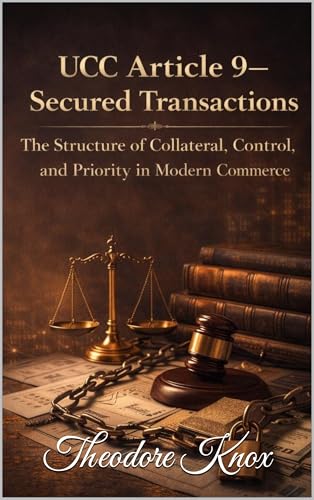 UCC Article 9 — Secured Transactions: The Structure of Collateral, Control, and Priority in Modern Commercehttps://www.amazon.com/dp/B0GTGC7RFR
 THE UCC-1 REVOLUTION: How Secured Parties Reclaim Private Rights in a Corporate Worldhttps://www.amazon.com/dp/B0G76MXJB2